
Glycomics Program
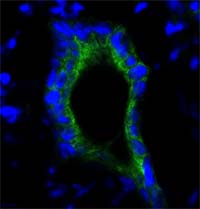
Tn-MUC1 in colonic cancer cell
Vision: to understand how glycans impinge on the biology of cells during tissue formation, inflammation, immunity and cancer growth, and how this can be exploited for early detection and treatment of disease.
Research focus: The glycome is considered the third language of life after the genome and the proteome. It comprises the myriad of sugars, also known as the complex carbohydrates, which cover the surface of our proteins and cells. Complex carbohydrates are essential for fundamental cellular functions, and changes to the glycome are often correlated with increased susceptibility to infection, metabolic disease and cancer. Additionally, hereditary defects in the glycome can cause a wide variety of symptoms such as cognitive impairment and developmental disability.
Copenhagen Center for Glycocalyx Research (CGR) explore how the cell surface shapes life and health. The research focuses on the glycocalyx – the complex layer of glycans and glycan-binding proteins that governs how cells communicate with each other and their surroundings. We investigate how inflammation and degenerative diseases disrupt these networks, altering cellular signaling and surface protein patterns. By mapping these changes, we aim to uncover new biological insights and translate them into more precise diagnostics and therapies that can improve human health.
Two strategic approaches have been developed to interrogate the functions of the glycome:
The SimpleCell strategy entails a systematic reduction of the complexity of the glycome by genetically simplifying the glycosylation in cells. The glycomes and glycoproteomes of modified cells are then mapped by mass spectrometry. This strategy has been successful in discovering new functions of glycosylation in diseases, and has even lead to discovery of new types of protein glycosylation.
The GlyMAP strategy uses a glycogenome approach to study the glycome by addressing all genes involved in glycosylation. Population exome data is explored for potential common deleterious glycogenes, and candidates are functionally validated for disease discovery.
Faculty
Clausen, Henrik Professor
Wandall, Hans H. Professor
Halim, Adnan Associate Professor
Joshi, Hiren Associate Professor
Miller, Rebecca Associate Professor
Narimatsu, Yoshiki Associate Professor
Schjoldager, Katrine Associate Professor
Vakhrushev, Sergey Associate Professor
Bagdonaite, Ieva Associate Professor