
Narimatsu Group
The group aims to understand how glycan-binding proteins read sugar patterns on cells and how these interactions shape immunity and relationships with microbes.
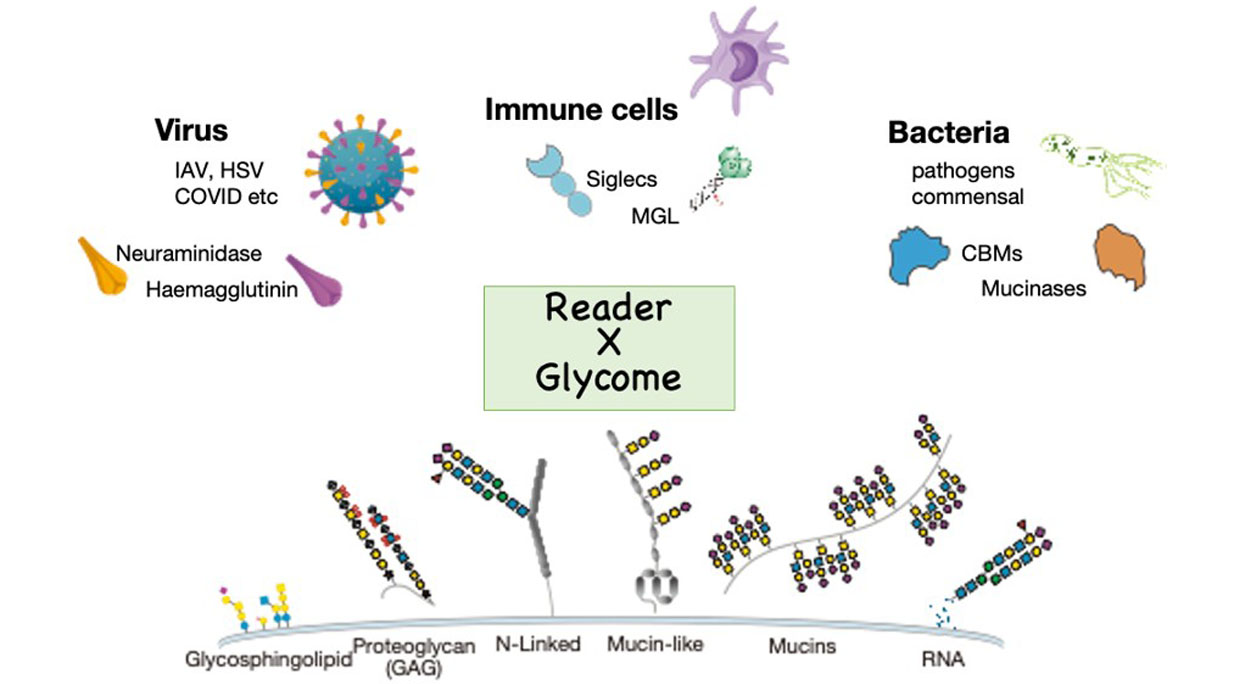
Glycans participate in virtually every aspect of cell biology, and many of their functions depend on recognition by glycan-binding proteins—the readers of glycan cues. These interactions regulate immune homeostasis, host–microbe relationships and disease processes. Yet many of the natural glycan cues and the mechanisms underlying their recognition remain poorly understood. In essence, we have not yet learned to fully read the language of glycans.
My group investigates how glycan recognition depends on the context in which glycans are presented, including their clustering, spatial organization and attachment to proteins and lipids. We combine genetic glycoengineering with cell-based glycan arrays and defined glycoprotein mimetics to study these interactions. By connecting studies in living cells with biochemical, biophysical and structural analyses, we aim to uncover the molecular rules of glycan recognition and develop tools to explore their biological functions
- GlycoReader — Decoding glycan recognition with cell-based glycan arrays
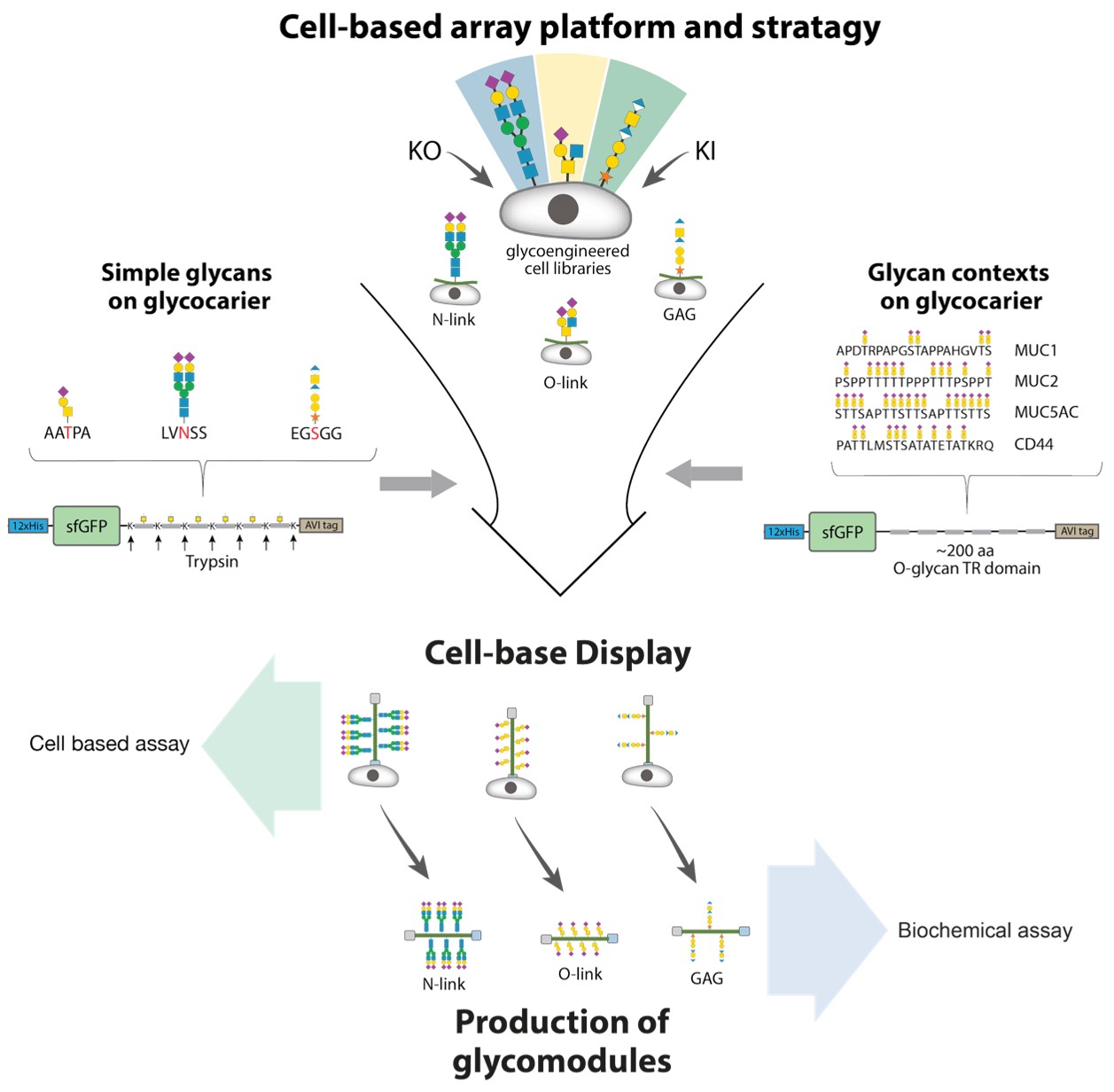
GlycoReader aims to uncover how glycan-binding proteins read the molecular cues presented by glycans on human cells. Our central hypothesis is that recognition depends on both the structures of individual glycans and their presentation on proteins and lipids with glycan clustering, spacing and carrier context create recognition signals that are difficult to capture using isolated sugar structures. At the core of this programme is our unique Cell-Based Glycan Array platform. We use genetic glycoengineering to create libraries of isogenic cells with distinct, defined glycosylation capacities. Each cell line displays a different combination of glycan features within the environment of the cell surface. Comparing recognition across these libraries allows us to identify the key glycan features involved in binding and connect them to their underlying biosynthetic pathways.
We complement these libraries with the display of selected mucin and glycoprotein domains, allowing us to investigate how related glycan structures are recognised on different protein carriers. We also develop artificial Glycocarriers—engineered protein scaffolds that carry clustered glycans in defined arrangements which provide additional ways to examine how glycan arrangement and clustering contribute to recognition. This platform supports the production of defined glycans, glycoprotein mimetics and mucin fragments for biochemical, biophysical and structural studies. By connecting discovery on cells with detailed analysis of isolated molecules, we aim to establish the molecular rules of glycan recognition. We apply this approach across three interconnected areas: immune regulation, host–virus interactions and the microbiome.
- Glycan signals in immune regulation
Glycan-binding immune receptors interpret molecular signals on host cells and help regulate immune responses. However, the natural glycan ligands of many receptors remain incompletely understood. We investigate how glycan structure and presentation contribute to selective recognition by immune receptors, with a particular focus on Siglecs. Using cell-based glycan arrays and defined glycoprotein mimetics, we examine how sialylation, sulfation and glycan clustering influence receptor binding. We also investigate how the type of glycoconjugate or protein backbone contributes to recognition, asking why receptors distinguish between glycoproteins carrying related sugar structures.
Our goal is to identify biologically relevant glycan ligands and understand how their recognition contributes to immune regulation. This knowledge may provide a foundation for future approaches to modulating glycan-dependent immune responses.
- Glycan recognition in host–virus interactions
Many viruses recognize glycans during their initial interactions with host cells. Influenza viruses recognize sialic acid-containing glycans, but individual sugar structures alone do not fully explain these interactions. The density, arrangement and presentation of glycans on proteins and lipids also contribute to recognition.
We use our cell-based glycan arrays and defined glycoprotein mimetics to investigate these interactions in biologically relevant settings. By connecting glycoengineering with virology, biophysical analysis and structural biology, we examine how glycan context contributes to selective recognition by influenza and other respiratory viruses.
Our particular interest is how viral recognition of cell-surface glycans relates to interactions with the glycan-rich environment of mucosal surfaces. Our goal is to clarify the molecular principles underlying host–virus interactions and improve our understanding of the protective roles of mucus and the glycocalyx.
- Mucin mimetics at the host–microbiome interface
Mucins are densely glycosylated proteins that form a major component of mucus and help shape the environment occupied by the microbiota. Their protein sequences and diverse O-glycan patterns provide molecular cues that influence microbial recognition and mucin turnover.
We investigate how microorganisms and their glycan-binding proteins distinguish between different mucins and glycan patterns. Our cell-based mucin arrays and defined human mucin mimetics allow us to examine the contributions of the mucin backbone and its attached glycans to these interactions.
Building on these platforms, we aim to develop tools for identifying mucin-binding microorganisms and proteins, measuring mucin-degrading activities and investigating mucus barrier properties. By making defined mucin mimetics available in useful experimental formats, we hope to support wider studies of host–microbiome relationships and the biological functions of human mucins.
Complete publication list: https://scholar.google.com/citations?user=9nJGIDIAAAAJ&hl=en
- Goerdeler F, Hornikx DLAH, Valckx VTC, Chien YC, de Wit D, Jaroentomeechai T, Jaeger M, Furukawa S, Tseng HC, Jung J, Schmidt EN, Khoo KH, Miller RL, Germeraad WTV, Bos GMJ, Macauley MS, Clausen H, Büll C, Narimatsu Y. Siglec-7 and -15 recognize repeated clustered sulfo-sialo O-glycan motifs on select O-glycoproteins. (2026) Nat Commun. In press.
- Goerdeler F, Narimatsu Y, Büll C. Cell-based mucin arrays. (2026) Methods Enzymol. 732:177-218.
- Kyrila G, Ahmed S, Borgenvik A, Christen D, Misek SA, Zhang A, Furukawa S, Joshi HJ, Narimatsu Y, Beroukhim R, Bandopadhayay P, Halim A. O-mannosylation and furin processing are critical maturation events for the KIAA1549 protein implicated in pediatric pilocytic astrocytomas. (2026) J Biol Chem. Aug 7:113403. doi:10.1016/j.jbc.2026.113403.
- Wu X, Liu M, Blekkenhorst L, Verbruggen MHL, Schuurman NNMP, Chao L, Ong JY, Wennekes T, van Dijk LLA, de Vries RD, van Kuppeveld FJM, Clausen H, Narimatsu Y, de Vries E, de Haan CAM. Paramyxovirus infection driven by heteromultivalent sialoglycotope binding. (2026) Proc Natl Acad Sci U S A. Apr 28;123(17):e2530862123.
- Narimatsu Y, Pleguezuelos-Manzano C, Hornikx D, Goerdeler F, Jaroentomeechai T, Flores K, Narimatsu S, Boot C, Hansen L, Durbesson F, Vincentelli R, Comstock L, Clevers H, Taleb V, Corzana F, Henrissat B, Clausen H, Hurtado-Guerrero R, Büll C. Discovery of a secreted Bacteroides fragilismucinase that cleaves mucins with bis-T O-glycans through a carbohydrate binding module-dependent mechanism. (2026) Gut Microbes. 31;18(1):2644983.
- Taleb V, Sanz-Martínez I, Serna S, Bort-Griñó M, Narimatsu Y, Furukawa S, Reichardt NC, Clausen H, Merino P, Hurtado-Guerrero R. Plant fucosyltransferase FUT11 distorts the sugar acceptor to catalyze via a transient oxocarbenium intermediate mechanism. (2026) Nat Commun. Jan 23;17(1):1960.
- Li Z, Di Vagno L, Chawla H, Ni Cheallaigh A, Critcher M, Sammon D, Briggs DC, Chung N, Chang V, Mahoney KE, Cioce A, Murphy LD, Chen YH, Narimatsu Y, Miller RL, Willems LI, Malaker SA, Huang ML, Miller GJ, Hohenester E, Schumann B. Xylosyltransferase engineering to manipulate proteoglycans in mammalian cells. (2026) Nat Chem Biol. Jan 20.
- Tsukamoto Y, Aoki K, Kama Y, Hosokawa H, Saiki W, Tsukamoto N, Kato K, Hosokawa Y, Sato R, Uesugi N, Fujita Y, Fukazawa K, Funada D, Suzuki F, Kurebayashi Y, Urata Y, Uchiyama S, Wang W, Minami A, Takahashi T, Tiemeyer M, Narimatsu Y, Okajima T, Takeuchi H. Differential O-glucose elongation on a specific EGF repeat within the canonical ligand-binding domain regulates DLL1/4-NOTCH1 signaling. (2025) Proc Natl Acad Sci U S A. Oct 28;122(43):e2504827122.
- Jaroentomeechai T, Veloz B, Soares CO, Goerdeler F, Grosso AS, Büll C, Miller RL, Furukawa S, Gin. Alcober I, Taleb V, Merino P, Ghirardello M, Compa..n I, Coelho H, Dias JS, Vincentelli R, Henrissat B, Joshi HJ, Clausen H, Corzana F, Marcelo F, Hurtado-Guerrero R, Narimatsu Y*. Microbial binding module employs sophisticated, clustered saccharide patches to selectively adhere to mucins. (2025) Nat Commun. 13;16(1):9058
- Wu X, Luteijn RD, Lozano-Andrés E, Marougka K, Li W, Narimatsu Y, van Kuppeveld FJM, Bosch BJ, Lebbink RJ, Vries E, de Haan CAM. Identification of β4GALNT2 as an anti-hPIV3 factor through genome-wide CRISPR/Cas9 library screening. (2025) Emerg Microbes Infect. Dec;14(1):2529895.
- Chen J, Goerdeler F, Jaroentomeechai T, Hernandez FXS, Wang X, Clausen H, Narimatsu Y, Satchell KJF. VibrioMARTX toxin binding of biantennary N-glycans at host cell surfaces. (2025) Sci Adv. Apr 11;11(15): eadt0063.
- Brauer BK, Chen Z, Beirow F, Li J, Meisinger D, Capriotti E, Schweizer M, Wagner L, Wienberg J, Hobohm L, Blume L, Qiao W, Narimatsu Y, Carette JE, Clausen H, Winter D, Braulke T, Jabs S, Voss M. GOLPH3 and GOLPH3L maintain Golgi localization of LYSET and a functional mannose 6-phosphate transport pathway. (2024) EMBO J. 43(24):6264-6290.
- Jaroentomeechai T, Karlsson R, Goerdeler F, Teoh FKY, Grønset MN, de Wit D, Chen YH, Furukawa S, Psomiadou V, Hurtado-Guerrero R, Vidal-Calvo EE, Salanti A, Boltje TJ, van den Bos LJ, Wunder C, Johannes L, Schjoldager KT, Joshi HJ, Miller RL, Clausen H, Vakhrushev SY, Narimatsu Y. Mammalian cell-based production of glycans, glycopeptides and glycomodules. (2024) Nat Commun. 8;15(1):9668.
- Elzinga J, Narimatsu Y, de Haan N, Clausen H, de Vos WM, Tytgat HLP. Binding of Akkermansia muciniphilato mucin is O-glycan specific. (2024) Nat Commun 29;15(1):4582.
- Bagdonaite I, Abdurahman S, Mirandola M, Pasqual D, Frank M, Narimatsu Y, Joshi HJ, Vakhrushev SY, Salata C, Mirazimi A, Wandall HH. Targeting host O-linked glycan biosynthesis affects Ebola virus replication efficiency and reveals differential GalNAc-T acceptor site preferences on the Ebola virus glycoprotein. (2024) J Virol. 17:e0052424.
- Narimatsu Y, Christian Büll, Víctor Taleb, Qinghua Liao, Ismael Compañón, David Sánchez-Navarro, Fabien Durbesson, Renaud Vincentelli, Francisco Corzana, Carme Rovira, Bernard Henrissat, Henrik Clausen, Hiren J. Joshi, Ramon Hurtado-Guerrero. A Family of Di-Glutamate Mucin Degrading Enzymes that Bridges Glycan Hydrolases and Peptidases. (2024) Nat Catalysis 7:386-400
- Anggara K, Sršan L, Jaroentomeechai T, Wu X, Rauschenbach S, Narimatsu Y, Clausen H, Ziegler T, Miller RL, Kern K. Direct observation of glycans bonded to proteins and lipids at the single-molecule level. (2023) Science 382(6667):219-223
- Büll C, Nason R, Sun L, Van Coillie J, Madriz Sørensen D, Moons SJ, Yang Z, Arbitman S, Fernandes SM, Furukawa S, McBride R, Nycholat CM, Adema GJ, Paulson JC, Schnaar RL, Boltje TJ, Clausen H, Narimatsu Y. (2021) Probing the binding specificities of human Siglecs by cell-based glycan arrays. Proc Natl Acad Sci USA 118:e2026102118
- Nason R, Büll C, Konstantinidi A, Sun L, Ye Z, Halim A, Du W, Sørensen D, Durbesson F, Furukawa S, Mandel U, Joshi HJ, Dworkin L, Hansen L, David L, Iverson TM, Bensing BA, Sullam PM, Varki A, de Vries E, de Haan CAM, Vincentelli R, Henrissat B, Vakhrushev SY, Clausen H, Narimatsu Y. (2021) Display of the human mucinome with defined O-glycans by gene engineered cells. Nat Commun12:4070
- Narimatsu Y, Joshi HJ, Nason R, Van Coillie J, Karlsson R, Sun L, Ye Z, Chen YH, Schjoldager KT, Steentoft C, Furukawa S, Bensing BA, Sullam PM, Thompson AJ, Paulson JC, Büll C, Adema GJ, Mandel U, Hansen L, Bennett EP, Varki A, Vakhrushev SY, Yang Z, Clausen H. (2019) An Atlas of Human Glycosylation Pathways Enables Display of the Human Glycome by Gene Engineered Cells. Molecular Cell 75:394-407
- Ajit Varki (University of California San Diego, USA)
- James C Paulson (The Scripps Research Institute, USA)
- Lance well (Complex Carbohydrate Research Center, University of Georgia, USA)
- Mathew Macauley (University of Alberta, Canada)
- Katharina Ribbeck (Massachusetts Institute of Technology, USA)
- Karla JF Satchell (Northwestern University, USA)
- Josh LaBaer (Arizona State University, USA)
- Ludger Johannes (Institut Curie / INSERM, France)
- Bernard Henrissat, Renaud Vincentelli (Marseille University, France)
- Christian Büll (Radboud University, Netherlands)
- Erik de Vries, (Utrecht University, Netherlands)
- Cornelis AM de Haan (Utrecht University, Netherlands)
- Ramon Hurtado-Guerrero (University of Zaragoza, Spain)
- Francisco Corzana (University of La Rioja, Spain)
- Filipa Marcelo (NOVA University Lisbon, Portugal)
- Benjamin Schumann (TUD Dresden University of Technology, Germany)
- Kay-Hooi Khoo (Academia Sinica, Taiwan)
- Hideyuki Takeuchi (University of Shizuoka, Japan)
 Novo Nordisk Foundation Hallas Møller Ascending Investigator award
 EU ITN (GlycanDrug, B. ACTIVE, GlycoBiota)
 Group Leader
Yoshiki Narimatsu
associate professor
yoshiki@sund.ku.dk
(+45) 35 33 55 28
CV, publications, etc.